By DB Sikes

Introduction
Stamped backs on T68 Heroes of History cards have long been interpreted through the lens of early tobacco distribution. Names impressed onto card backs are often viewed as remnants of wholesale networks, jobbers, retailers, or regional handlers who moved tobacco products from factory to consumer during the earliest years of circulation.
Among these, the purple C. J. Zimmerman stamp has stood as one of the more recognizable and frequently discussed examples. For years, the mark has generally been interpreted as evidence of a tobacco jobber operating within the original distribution window of the T68 issue.
However, recent comparative evidence suggests the story may be more complicated.
Newly surfaced grouped examples, repeated overlapping stamp behaviors, alphabetic stamp sequences, and a potentially related date impression collectively challenge a simple jobber-only explanation. While the Zimmerman mark was once confidently assigned to the tobacco distribution chain, the evidence now points toward a more nuanced interpretation, one that may place the stamp somewhere between organized tobacco movement and early hobby era handling.
What emerges is not certainty, but transition.
The Zimmerman stamp may represent a bridge between commercial circulation and post-distribution interaction.
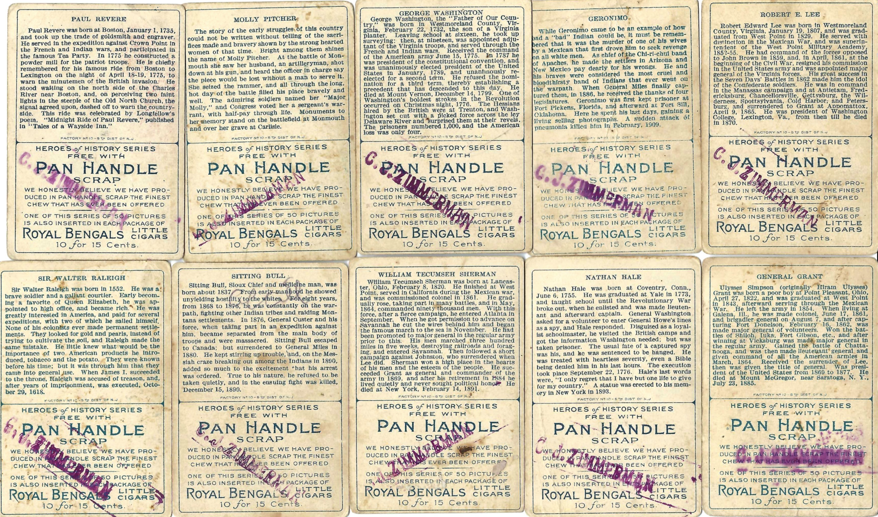
Card Subject Overview
Among the most fascinating research paths in T68 collecting are stamped backs, small but revealing traces of ownership, movement, and handling layered onto cards long after they left the presses of the American Lithographic Company.
The C. J. Zimmerman mark is particularly distinctive.
Typically applied in purple ink and positioned diagonally across the lower portion of the reverse, Zimmerman examples appear with striking consistency of placement and tone. Yet despite their recognizable appearance, these stamps remain unusually difficult to classify.
Unlike many clearly attributable tobacco jobber or retail marks, Zimmerman examples lack supporting identifiers.
There is:
• no city designation
• no tobacco business title
• no wholesale reference
• no confirmed documentary attribution
Instead, collectors are left with only a name.
That absence of context has become increasingly important as additional examples surface.
What once appeared to be a straightforward jobber mark now raises larger questions regarding chronology, intent, and function.
New Comparative Material
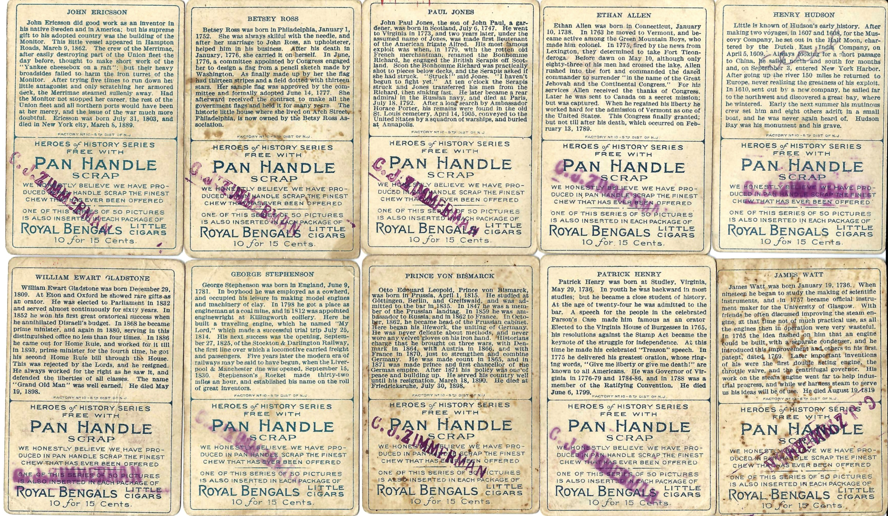
Recent acquisition and examination of a grouped Zimmerman lot has provided the strongest comparative evidence yet available for study.
Rather than isolated examples appearing sporadically across years of collecting, multiple Zimmerman-stamped T68 cards can now be examined side by side.
The sample reveals several notable consistencies:
• repeated diagonal placement across the lower reverse
• remarkably similar purple ink tone and pressure
• recurring overlap with additional stamp elements
• repeated association with alphabetic sequences
Viewed collectively, the Zimmerman examples appear less random than previously assumed. The consistency suggests repeated handling by a single source or related process rather than accidental or unrelated later markings.
Yet paradoxically, the same grouped evidence also introduces new complications.
The stamps do not behave like conventional wholesale identifiers.
Instead of clean commercial branding, several examples display overlapping impressions, partial strike behavior, and non-commercial alphabetic sequences, raising new questions regarding their purpose.
The grouped material strengthens the case for intentional repetition while simultaneously weakening a simple jobber interpretation.
Alphabet Stamps and the Problem of Interpretation
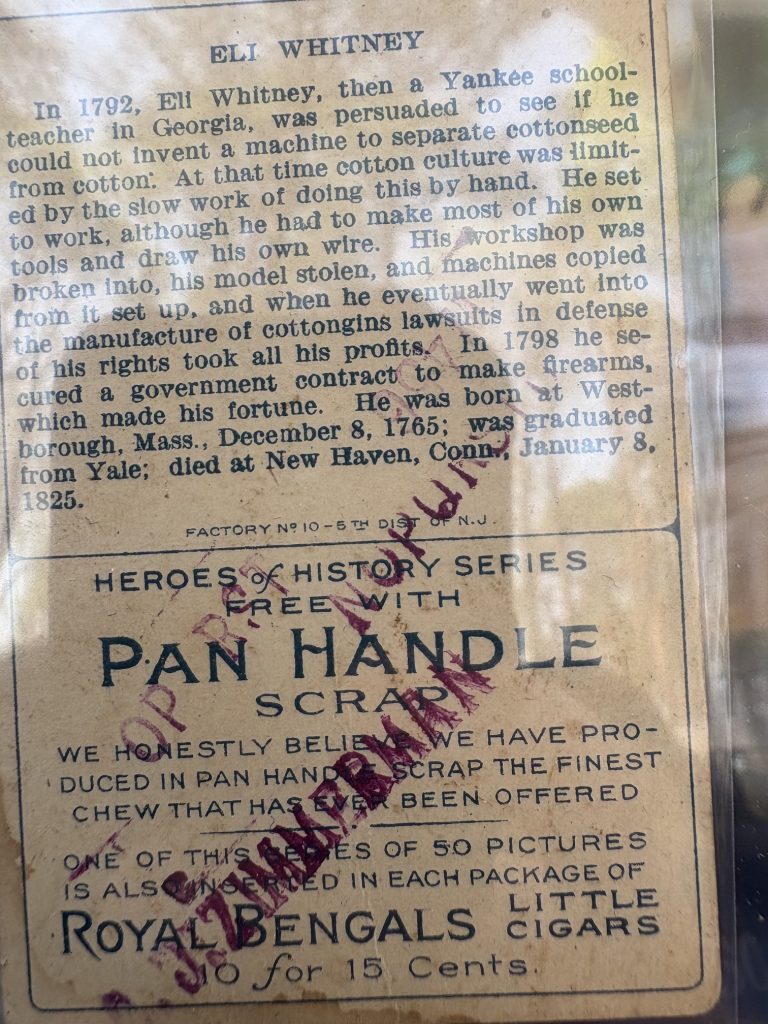
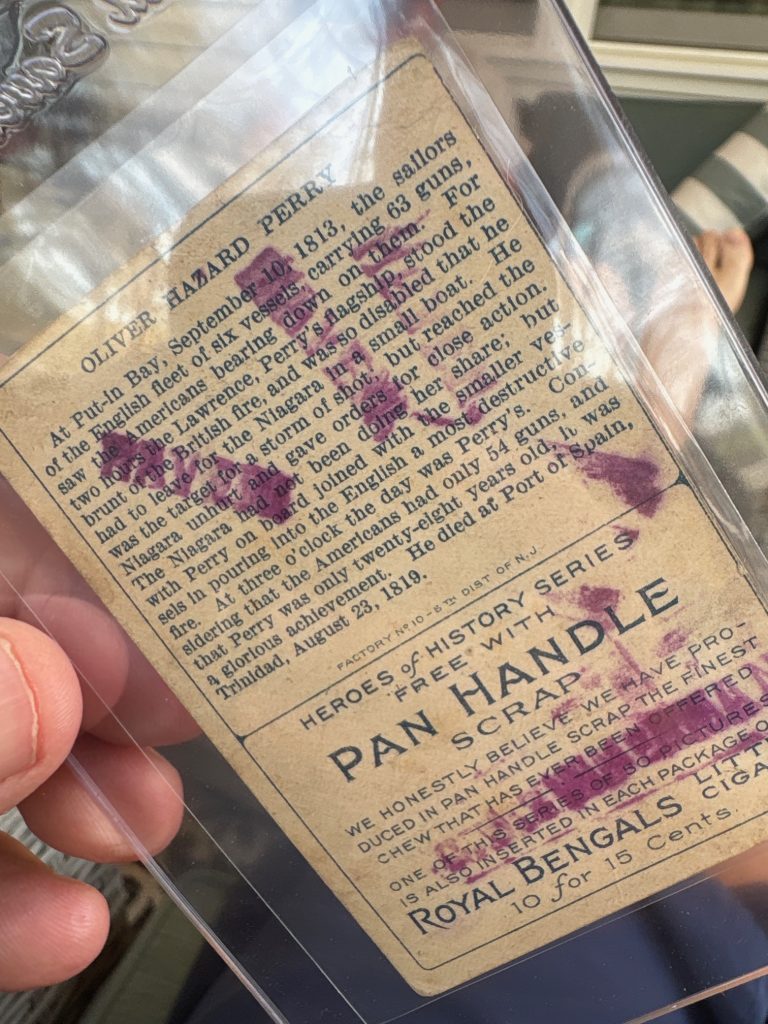
Perhaps the most important recent discovery involves alphabetic stamp sequences appearing alongside Zimmerman impressions.
Examples include:
OPQRST
NOPQRS
These markings appear in matching or near-matching purple ink and often overlap or coexist directly with Zimmerman impressions.
Their structure is revealing.
These are not business names.
They are not inventory codes.
They are not wholesale identifiers.
Instead, they resemble sequential letter exercises or test impressions consistent with alphabet stamp kits commonly used in offices, shops, and later collector environments.
This distinction matters.
A tobacco jobber responsible for structured wholesale movement would be expected to mark inventory with commercial identifiers, location data, or accounting references.
Alphabet runs suggest something different:
interaction.
The cards appear to have been handled, tested upon, or repeatedly marked by someone actively using stamps rather than merely identifying product for movement through distribution channels.
This behavior introduces an element of informality that sits awkwardly within a strict Layer 2 jobber classification.
Reconsidering the “May 31” Stamp
Earlier interpretation of one partially legible example suggested a possible reading of:
“May 3, 31”
At first glance, this raised the possibility of a full office-style date stamp, potentially placing Zimmerman-related activity in 1931, approximately two decades after original T68 distribution.
Newly surfaced comparison material complicates that interpretation.
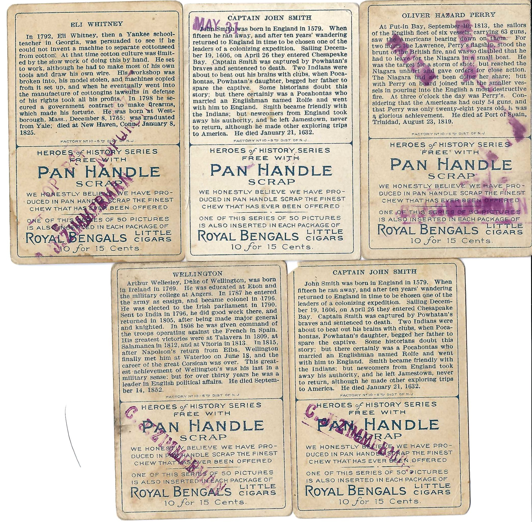
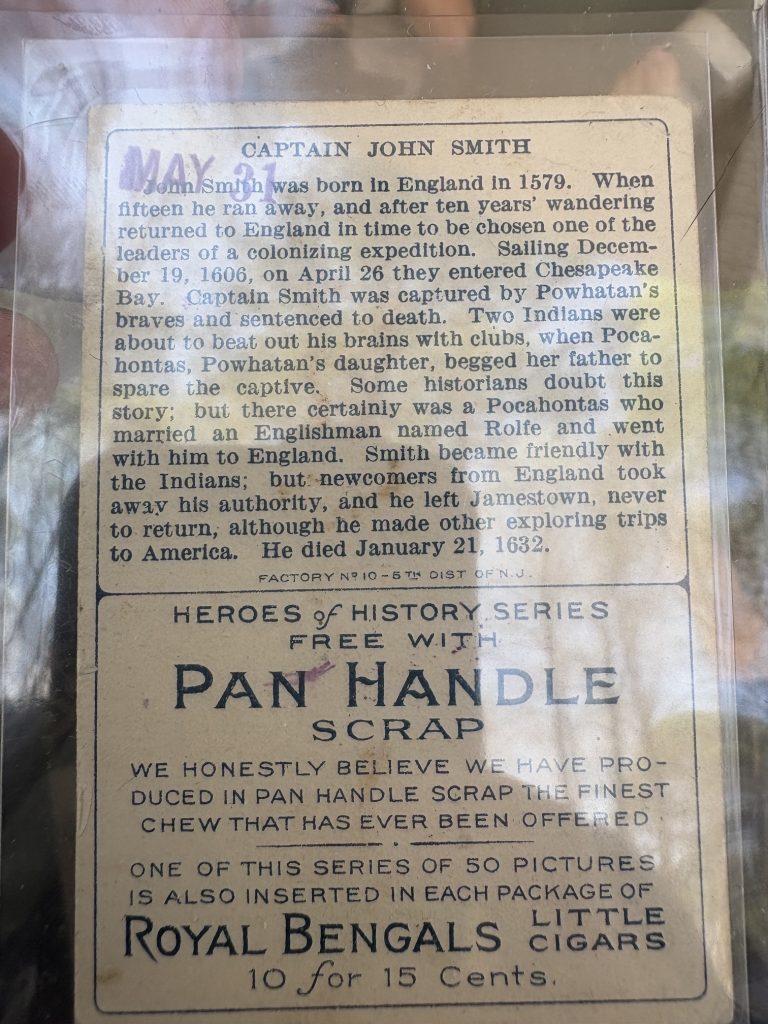
A recently identified Pan Handle Scrap Captain John Smith example bears a clearly visible “MAY” stamp impression without an accompanying Zimmerman mark. The format appears visually similar to the previously observed Zimmerman-associated example.
This comparison introduces a critical possibility:
the reading may instead represent:
“May 31”
rather than “May 3, 31.”
At present, the impression remains incomplete and unresolved.
Yet the distinction matters enormously.
If interpreted as a complete date including year, the stamp would place activity firmly outside the original tobacco circulation period and align more naturally with early hobby or dealer-level handling.
If instead interpreted as a month-and-day notation, the evidence becomes more ambiguous, pointing toward repeated marking behavior without definitively resolving chronology.
Either reading weakens the confidence of a purely original-distribution explanation.
Reassessing Zimmerman Through the Four-Layer Lifecycle Model
Under the established four-layer lifecycle framework for T68 stamped backs, markings generally fall into one of four categories:
Layer 1 — Factory Control (1911 to 1913)
Layer 2 — Jobber Distribution (1911 through early tobacco circulation)
Layer 3 — Dealer and Early Hobby Market (1930s to 1960s)
Layer 4 — Collector Ownership and Personal Marking (Post 1960s)
The Zimmerman stamp was previously classified within Layer 2 as a probable tobacco jobber mark.
However, recent evidence introduces inconsistencies with that placement.
Several characteristics now stand out:
• absence of geographic or business identification
• recurring alphabet stamp behavior inconsistent with commercial inventory practice
• overlapping stamp impressions suggestive of repeated handling
• possible association with later-style date marking conventions
• appearance as individually surfaced examples rather than tightly clustered tobacco finds
None of these observations independently disprove a jobber origin.
Taken together, however, they complicate it.
The evidence no longer comfortably supports a simple wholesale attribution.
Instead, Zimmerman may best be understood as occupying a transitional position between Layer 2 and Layer 3.

A Transitional Classification
At present, the most responsible working classification is:
C. J. Zimmerman
Provisional Transitional Classification
Late Distribution / Early Dealer Handling
(circa 1910s through early 1930s)
This interpretation preserves the possibility of an earlier tobacco connection while acknowledging increasingly persuasive evidence of later interaction.
Rather than assuming Zimmerman functioned strictly as a tobacco jobber, the evidence may support a broader range of possibilities:
• a dealer handling older tobacco material
• a regional intermediary operating after original distribution
• an early hobby participant interacting with cards as collectibles
• or a hybrid figure bridging late commercial movement and emerging collector behavior
At present, certainty remains elusive.
But uncertainty itself is meaningful.
The cards increasingly suggest not simply movement through a system, but interaction by an individual.
From Distribution to Interaction
Earlier interpretations emphasized consistency as evidence of structured tobacco distribution.
The new evidence points toward something more complex.
Repeated impressions.
Alphabet sequences.
Layered marks.
Partial date conventions.
These are not merely signs of inventory movement.
They are signs of contact.
Someone handled these cards.
Someone tested stamps.
Someone repeatedly interacted with them beyond their original life as pack inserts.
What once appeared to be a straightforward commercial identifier now increasingly resembles evidence of transition, cards existing somewhere between tobacco object and collectible artifact.
Research Notes
• The C. J. Zimmerman stamp typically appears in purple ink and is applied diagonally across the lower reverse.
• Newly examined grouped examples reveal consistent placement and ink behavior across multiple subjects.
• Alphabetic stamp sequences including OPQRST and NOPQRS appear in association with Zimmerman examples.
• No confirmed Zimmerman example currently includes a city, state, tobacco business, or occupational identifier.
• Comparative analysis of a recently surfaced Captain John Smith Pan Handle Scrap example reveals a visually similar MAY stamp impression without Zimmerman attribution.
• The previously interpreted “May 3, 31” reading now warrants reconsideration and may instead represent a “May 31” impression, though no definitive conclusion can yet be reached.
• Current evidence supports reclassification of Zimmerman as an unresolved transitional stamp type between organized tobacco movement and early dealer or hobby-era handling.
Personal Reflection
The Zimmerman stamp once felt straightforward.
A name.
A presumed role.
A place within the machinery of tobacco distribution.
But the cards themselves tell a more complicated story.
They show overlap.
Experimentation.
Repetition without complete explanation.
They reveal hands interacting with objects rather than systems merely moving inventory.
What once seemed like a solved attribution now stands as something far more interesting:
an unresolved piece of evidence caught between eras, resisting simple classification.
And perhaps that uncertainty is what makes it worth studying.
Call for Contributions
The C. J. Zimmerman stamp remains an open research question.
Collectors with examples featuring:
• Zimmerman impressions
• alphabetic stamp sequences
• MAY date-style impressions
• overlapping or layered markings
• grouped provenance examples
are encouraged to share images and research observations.
The next breakthrough may already be sitting in someone’s binder.
Leave a Reply