Educational Annotations on T68 Heroes of History Cards
by DB Sikes
Introduction
For more than a century, collectors have studied T68 Heroes of History cards as artifacts of the early tobacco era. Attention has typically focused on the illustrated fronts, the range of tobacco brand backs, factory designations, and the distribution networks that carried these cards across the United States.
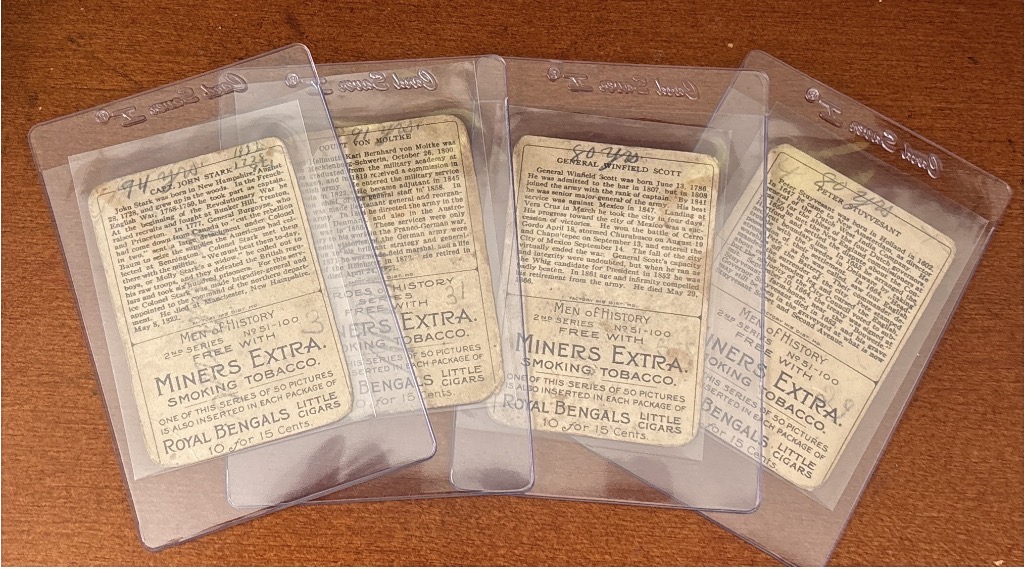
A recently acquired group of low grade Miners Extra examples reveals a different and more intimate dimension of their history. Rather than telling a story of production or circulation, these cards document how they were actually used. Several examples from the lot contain deliberate handwritten annotations, demonstrating that these objects functioned as active educational tools rather than passive collectibles.
Evidence of Historical Study
Among the group, multiple cards show carefully written calculations determining the age of the historical figure at death. These figures were derived directly from the printed birth and death dates within the biography. The handwriting appears systematic and intentional, suggesting that the user engaged directly with the historical content through arithmetic reasoning.
This type of interaction reflects more than casual handling. It indicates active engagement with the material, where the card became a source of both information and problem solving.
⸻
Expanding the Evidence: From Calculation to Penmanship
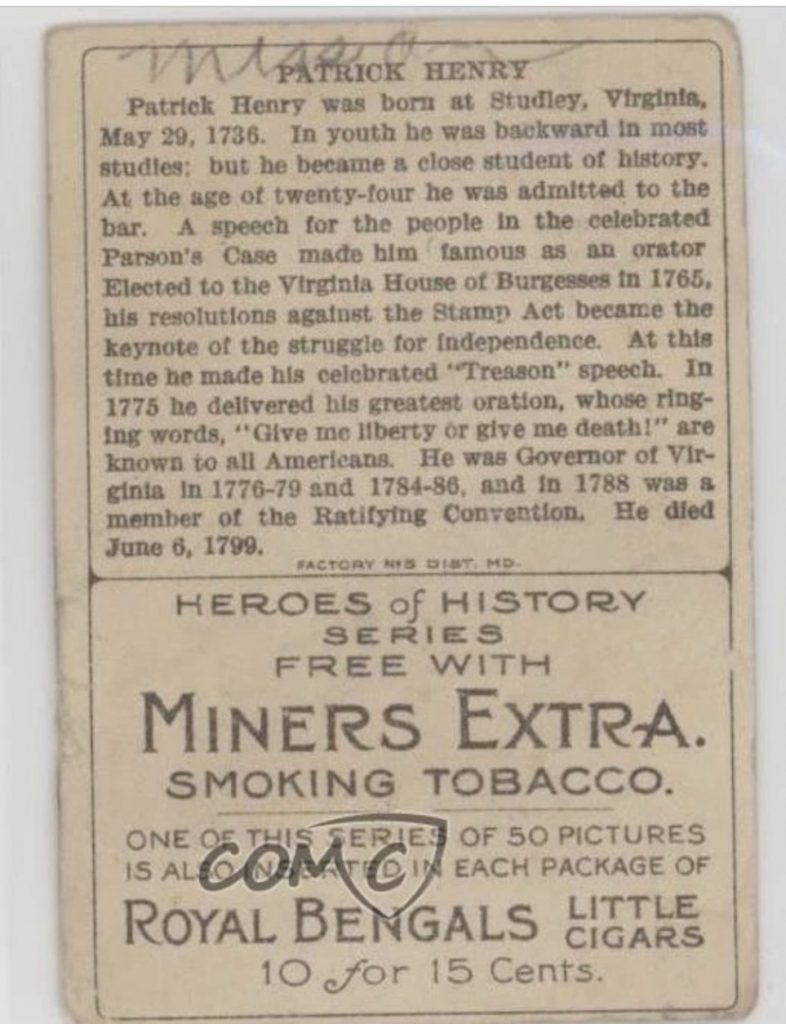
A newly acquired Patrick Henry example expands this pattern even further. Instead of numerical calculation, this card displays cursive penmanship practice across the top margin of the back. The writing shows attention to spacing, repetition, and letter formation consistent with early twentieth century instructional methods. This was not a quick note or idle scribble. It was deliberate practice.
This distinction is important.
The earlier examples demonstrate mathematical engagement with the historical text. The Patrick Henry card reflects linguistic and mechanical skill development. In this case, the student was not simply extracting information from the biography but using the card itself as a surface for practicing written expression.
A Set Designed to Teach
Taken together, these examples reveal multiple modes of interaction with the T68 set. The cards supported historical comprehension through reading, mathematical processing through calculation, and penmanship development through writing. This layered use reinforces the idea that these cards were not passive objects. They were tools.
The design of the T68 series helps explain this behavior. Each card contains a structured biography filled with dates, events, and narrative detail. These elements naturally invite engagement. Calculating age is a logical extension of reading the text. Practicing handwriting alongside it is equally intuitive.
In effect, the reverse of the card became a workspace.
⸻
Tobacco Cards in the Classroom and Home
This interpretation aligns with broader patterns observed across early tobacco issues. Surviving examples show handwritten ownership marks, checklist tracking, scrapbook mounting, and occasional educational notation. These interactions reflect a time when tobacco cards circulated primarily among children and were incorporated into informal learning environments within homes and classrooms.
The Patrick Henry example is particularly significant because it demonstrates that this interaction extended beyond simple information processing. It shows that these cards were used to develop foundational skills. Literacy and history intersect on a single surface, revealing a deeper level of engagement than is typically acknowledged in hobby literature.
⸻
Reconsidering Condition and Value
This evidence invites a reconsideration of how condition is evaluated. Markings traditionally viewed as damage may instead represent a form of functional provenance. They preserve a direct physical link between the card and its original user.
In this case, the handwriting does more than alter the card. It adds context.
It captures a moment in which a young student engaged with history not as an abstract subject, but as an active exercise. Reading, calculating, and writing all occurred on the same small piece of cardboard.
⸻
Conclusion
More than a century later, those actions remain visible.
Leave a Reply