New Discoveries Across T68 and Related Tobacco Issues
By DB Sikes
Introduction
For years, the mysterious “OK” overstamp has quietly appeared on select early tobacco cards, often dismissed as a minor curiosity rather than a meaningful part of the distribution story.
Recent discoveries have changed that.
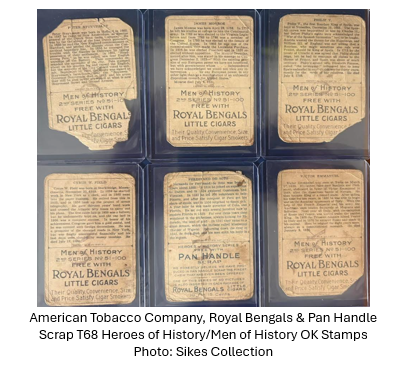
What once appeared to be a narrow marking tied to a single product has now been confirmed across multiple tobacco issues from the American Tobacco era, including Royal Bengals, Honest Long Cut, and, for the first time, Pan Handle Scrap.
This is no longer an isolated phenomenon. It is a pattern.
The eBay Wave
A recent wave of eBay transactions brought several new OK-stamped examples into the public market, including multiple T68 Royal Bengals backs and a newly confirmed Pan Handle Scrap example.
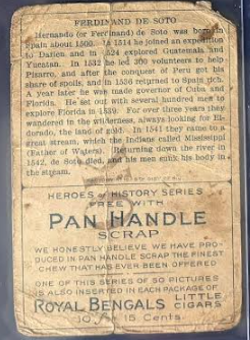
This development is significant.
Pan Handle Scrap has long been understood as part of a secondary distribution stream, often tied to repackaged or redistributed tobacco product. The appearance of an OK stamp on this format strongly suggests the mark was applied during the original handling process rather than as a later collector-era addition.
Collector Contribution: Lance Loken
Shortly after earlier research into trade-era markings was published, collector Lance Loken documented multiple OK-stamped examples from the T227 Series of Champions.
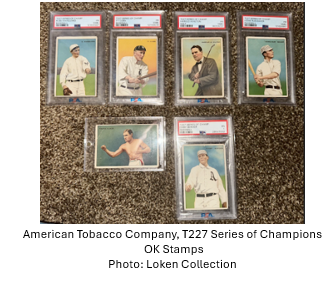
His findings included:
• Five confirmed Honest Long Cut backs
• Consistent stamp placement
• Uniform ink characteristics
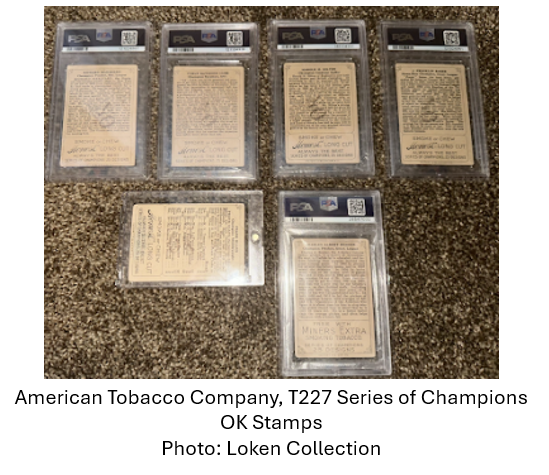
Most importantly, these examples were not isolated to a single subject or acquisition source.
“From what I have seen, they only seem to be on the Honest Long Cut backs.”
At the time, no examples had been observed on Miners Extra.
However, this contribution immediately expanded the scope of the investigation. What appeared to be brand-specific was clearly something broader.
Cross-Issue Presence
The OK stamp is now confirmed across:
• T227 Honest Long Cut
• T68 Royal Bengals
• T68 Pan Handle Scrap
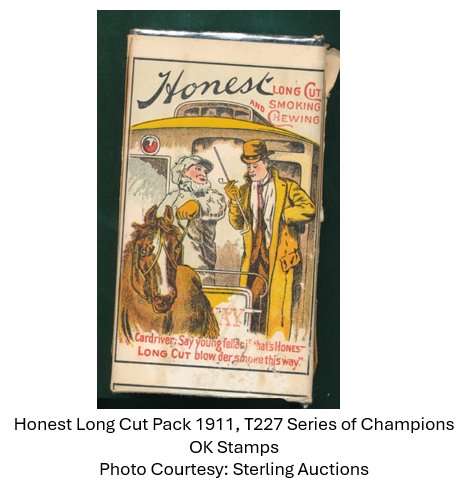
This establishes a critical point.
The mark is not tied to a single brand.
It is tied to process.
What the OK Likely Represents
Unlike jobber or dealer stamps such as C. J. Zimmerman or W. N. Beyer, which reflect redistribution or retail-level handling, the OK stamp presents a different profile.
Its defining characteristics include:
• Consistent placement across examples
• Uniform ink application
• Appearance across multiple brands and product lines
These traits strongly suggest a quality control or release mark applied during early distribution handling.
Rather than identifying ownership, the stamp likely signaled that material had been:
• Reviewed
• Approved
• Cleared for shipment
This aligns with known early twentieth century tobacco packing practices, where intermediary handlers often marked inspected goods before resale or routing through distribution channels.
A Process Marker, not a Personal One
OK-stamped examples consistently lack:
• Personal names
• Retail identifiers
• Ownership marks
They are simple, consistent, and functional.
This strongly supports the conclusion that the mark originated within the distribution chain rather than at the point of retail sale or later collector ownership.
Growing Evidence
The combined evidence from:
• Royal Bengals examples
• Pan Handle Scrap discoveries
• Lance Loken’s Honest Long Cut findings
builds a compelling case that the OK stamp represents a shared handling process across American Tobacco-era products.
What began as a curiosity now stands as a documented part of early distribution practice.
Ongoing Research
As more examples surface through auctions and private collections, the role of OK stamps continues to come into focus.
They are not damage.
They are not later additions.
They are not random.
They are trade-era artifacts.
Each documented example adds another piece to the reconstruction of how tobacco products—and the cards within them—moved through early twentieth century commercial networks.
Call for Contributions
If you have an OK-stamped example on:
• T68
• T227
• or other early tobacco issues
Please consider contributing to the ongoing research.
Contact:
sikesdb3@gmail.com
Every example matters. Every stamp adds to the story.
Leave a Reply